住まい
2026.02.26
2015-Sky Court|北海道札幌の住宅設計|緑(桜)を楽しむ家
住まい
2025.12.29
2019-Lapeinture|北海道札幌の住宅設計|素材の家
商業・サービス施設
2026.02.19
2012-はしもとクリニック|北海道札幌の医院設計|産婦人科


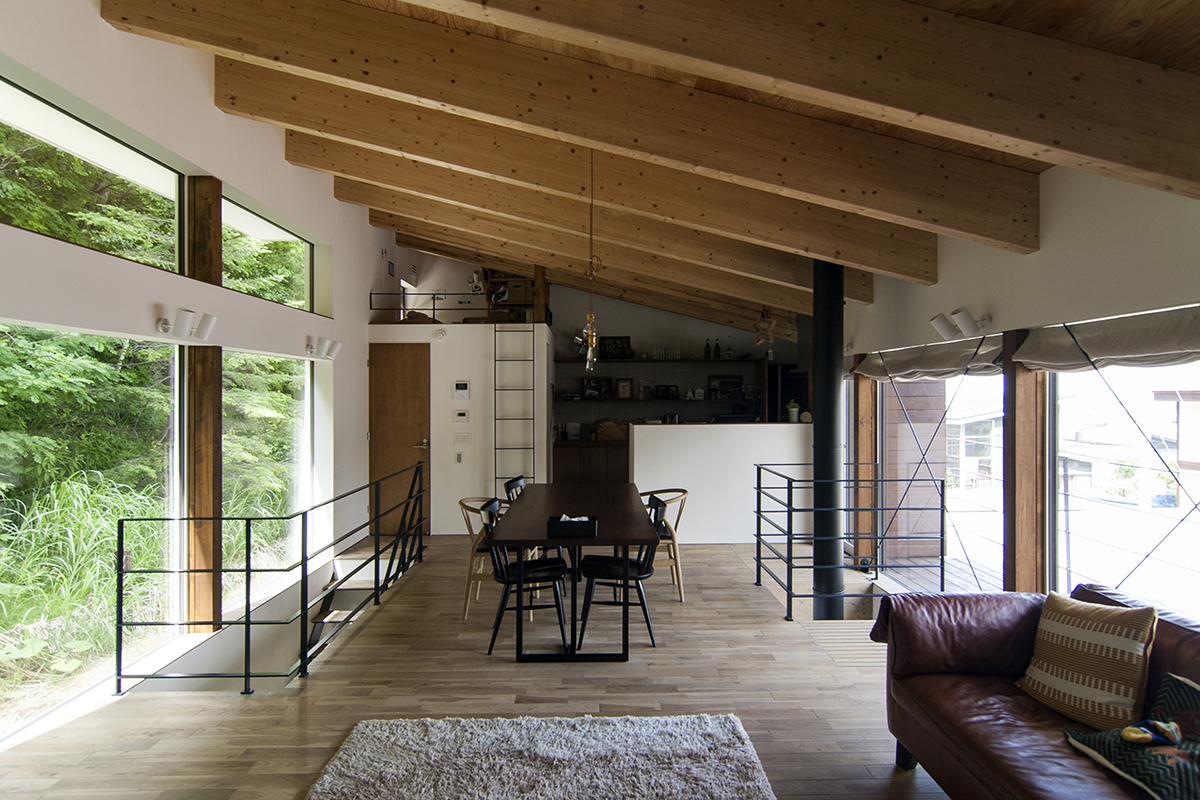
北海道札幌市に建つ住宅「le bord」。町と森の境界に位置する敷地で、片流れ屋根の構成としながら空気の流れや視線の抜けを丁寧に整えた住まいです。
le bordは、北海道札幌市に建つ住宅です。
敷地は「イヌエンジュの家」からほど近い場所にあり、住宅地の背後に森が迫る環境に位置しています。
町と森の接点ともいえる場所ですが、森と敷地のあいだには擁壁があり、地上レベルでは直接つながる関係にはなっていません。
一方で、2階の高さまで上がると視界は大きく開け、森の景色を感じることができます。
この敷地条件を読み取りながら、住まいの空間構成を整えました。
生活の中心となる空間は視線が抜ける高さに計画し、町のスケールと森の広がりの双方を感じられるようにしています。
建物は片流れ屋根のシンプルな構成とし、光や空気の流れを受け止めながら、周囲の環境に静かに馴染む住まいとなるよう設計しました。
“Le Bord” is a house in Sapporo located at the edge between the town and the forest, designed to frame air flow, light, and views through a simple shed-roof form.
Le Bord is a residence located in Sapporo, Hokkaido.
The site is located near the project known as “Inuenju House,” in an area where the residential neighborhood meets a forested landscape.
Although the forest lies close behind the site, a retaining wall separates it from the property at ground level.
However, once the eye level rises to the second floor, the view opens widely toward the forest.
The design process began by carefully interpreting this site condition.
The main living spaces are positioned at a height where the view expands outward, allowing residents to experience both the scale of the town and the presence of the forest.
The house takes a simple shed-roof form, shaping the flow of light and air while quietly settling into the surrounding environment.


家族が集うリビング・ダイニングは2階に配置し、
森へと視線が抜ける構成としました。
さらに町側へも連続する開口を設け、
森と町の双方へとつながる、抜けのある空間としています。
屋根は森の傾斜と呼応する片流れ屋根とし、
建築のシルエットそのものが周囲の地形と同調するよう計画しました。
1階の玄関は大きなホールとし、
趣味の道具や子どものスキーウェアを干せる土間空間を設けています。
ここには薪ストーブを設置し、暖気を2階へと押し上げ、
北側の窓付近で冷やされた空気が階段を通って1階へ戻る、
緩やかな空気循環をデザインしました。
冬はこの自然対流により温熱環境を整え、
夏は天井の高い位置に設けたロフトの窓を開放することで熱気を排出。
1階は土間に蓄えられた冷気によって、
安定した室内環境を保ちます。
森と町をつなぐだけでなく、
空気の流れまでも建築に取り込み、
四季を通して心地よく暮らせる住まいを目指しました。
The living and dining areas—where the family gathers—are placed on the second floor,
allowing the interior to connect visually with the forest canopy.
Continuous windows extend toward both the forest and the town,
creating a space that opens in two directions and mediates between contrasting environments.
The roof is designed as a single-pitch plane,
aligned with the natural slope of the forest,
so that the architectural silhouette resonates with the surrounding topography.
The entrance on the first floor is conceived as a generous hall with an earthen floor (doma),
large enough for hobbies and for drying children’s ski wear.
A wood-burning stove is installed here, pushing warm air upward to the second floor.
As the air cools near the north-facing windows, it returns gently down the stairwell,
creating a natural cycle of air circulation that enhances winter thermal comfort.
In summer, operable windows at the loft level—located at the highest part of the ceiling—release accumulated heat.
The first floor remains stable and cool, moderated by the thermal mass of the earthen floor.
Rather than simply connecting town and forest,
the house incorporates the movement of air itself into the architecture—
creating a home that responds quietly and comfortably to all four seasons.