住まい
2026.02.19
2012-WHITE BIRCH
住まい
2026.02.26
2015-Concurrent
住まい
2026.02.16
2008-BORDER


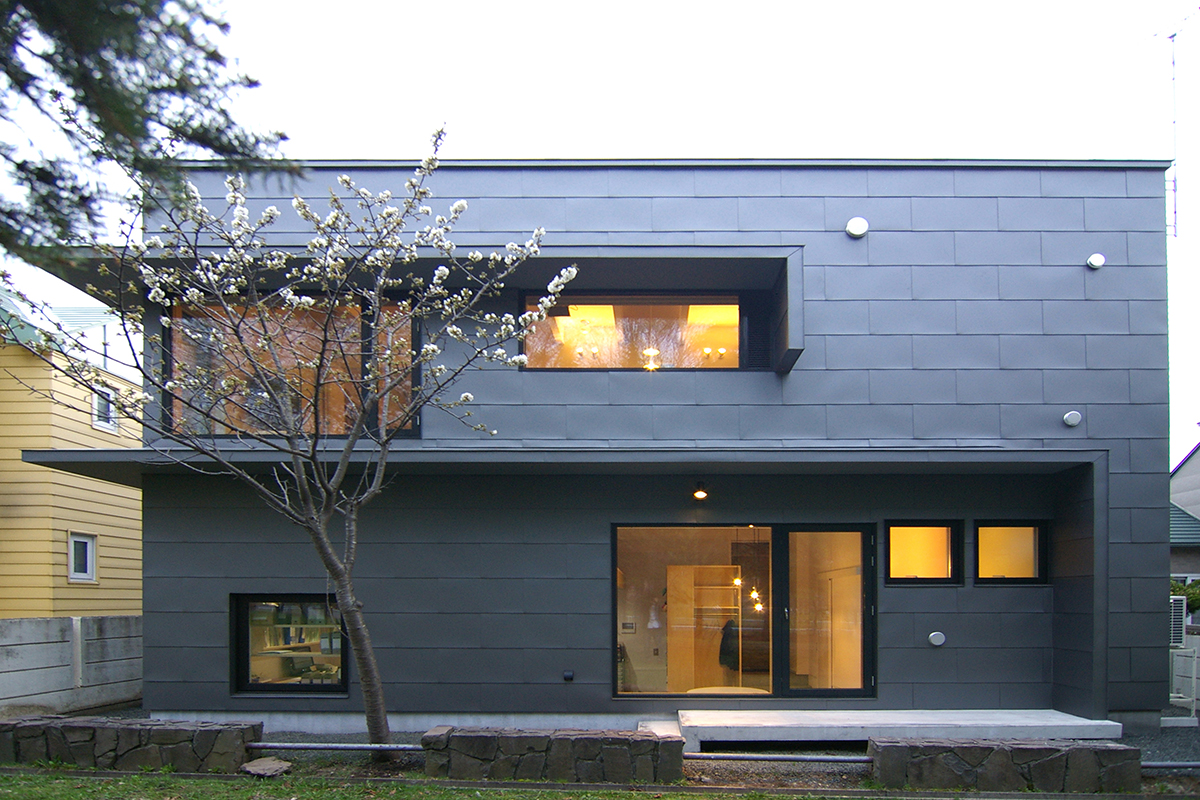
緑道にひらく、立体的な家。
敷地は西区の古い住宅街。
ハウスメーカーによって整えられた街並みは一見統一感があるものの、外観から間取りが想像できてしまう均質な風景が広がっていました。
クライアントはその中古住宅を購入し、数年暮らしていましたが、家族構成や働き方の変化により、既存の建物では対応できなくなっていました。
求められたのは、
車2台分の駐車スペース、外部物置、オフィス、住居とのプライバシーの確保、音楽スペース、十分な収納。
そのまま平面的に足し合わせれば、建築面積は敷地条件を超えてしまう要望でした。
Reading the site, expanding beyond its footprint.
The site is located in an older residential neighborhood in Nishi Ward.
Although the streetscape, originally developed by a house manufacturer, appears cohesive at first glance, each house reveals its floor plan through its exterior, creating a uniform and predictable environment.
The client had purchased one of these pre-owned houses and lived there for several years.
However, as family structure and lifestyle evolved, the existing building could no longer accommodate their needs.
The new program required two parking spaces, an exterior storage shed, a home office, privacy between office and living areas, a music space, and ample storage.
If these requirements were simply added in plan, the building footprint would have exceeded the allowable area.


既存住宅は、敷地裏手に広がる美しい緑道を十分に活かせていませんでした。
そこで主たる生活空間を緑道側へと大きく開き、豊かな外部環境を取り込む構成としました。
さらに2階中央に「穴(空の庭)」を設け、家族の気配や動きが立体的につながる間取りとしています。
1階のリビングは、緑道の緑と中庭の植栽に挟まれ、まるで森の中にいるかのような空間となりました。
限られた敷地条件の中で建築面積を抑えるため、空間は水平方向ではなく垂直方向へと展開。
1階オフィスは床レベルを地盤に近づけることで天井高さを確保し、一部に小屋裏収納を設けました。
2階も同様に、カーポート上部の床を下げることで高さを生み出し、ロフトや収納を立体的に組み込んでいます。
敷地を丁寧に読み込み、
空間を立体的に再編成することで、
面積以上の広がりと豊かさを生み出しました。
均質な住宅街の中にありながら、
森とつながり、家族の気配が交差する住まいです。
The former house barely engaged with the beautiful greenway behind the site—only a small kitchen window acknowledged its presence.
In response, the primary living spaces were opened generously toward the greenway, fully embracing the site’s most valuable asset.
At the center of the second floor, a void—an “open sky court”—was introduced, allowing visual connections across levels and enabling family members to sense one another’s presence.
On the ground floor, planting was added so that the living room is nestled between the greenery of the greenway and the internal garden, creating the feeling of being surrounded by a small forest.
To avoid expanding horizontally, the house was developed vertically.
The first-floor office floor level was set close to the ground to secure sufficient ceiling height, while partial attic storage was integrated above.
Similarly, on the second floor, the floor level above the carport was lowered to create generous ceiling height, making room for loft spaces and additional storage.
By carefully reading the site and organizing the program three-dimensionally rather than two-dimensionally,
the design achieves spatial richness beyond its numerical footprint.
Within a uniform residential neighborhood,
the house reconnects with nature and layers daily life vertically—
transforming constraints into spatial opportunity.